Showing posts with label depression. Show all posts

Wednesday, 8 July 2015

The ‘Muscle of the Soul’ may be Triggering Your Fear and Anxiety

The psoas major muscle (pronounced “so-as”) is often referred to as the deepest core, or as yoga therapist and film-maker Danielle Olson states, the “muscle of the soul.” This core-stabilizing muscle located near the hip bone affects mobility, structural balance, joint function, flexibility, and much more. In addition to its function to help keep the body upright and moving, the psoas is believed to allow you to connect with the present moment especially when it is stretched out and tension is released from the body.
Research indicates that the psoas is vital to our psychological wellbeing in addition to structural health. Liz Koch, author of The Psoas Book, states that our psoas “literally embodies our deepest urge for survival, and more profoundly, our elemental desire to flourish.” This means that there is a lot more to the psoas than one might initially think. It is entirely possible to harness healing pranic energy and improve mental health by keeping the psoas healthy.

Where is the Psoas?

The psoas is the principal muscle associated with physical stability. It stretches from the legs to the spine and is the only muscle connecting the legs to the spinal column. The muscle flares out from the T12 vertebrae, follows down the five lumbar vertebrae, before attaching to the top of the thigh bone.
The Reptilian Connection
In addition to connecting the legs and spine, the psoas is connected to the diaphragm. Breathing is modulated at the diaphragm, and it is also the location where many physical symptoms associated with fear and anxiety manifest. Koch believes that this is due to the direct link between the psoas and the most ancient part of our brain stem and spinal cord, called the reptilian brain.
According to Koch, “Long before the spoken word or the organizing capacity of the cortex developed, the reptilian brain, known for its survival instincts, maintained our essential core functioning.” The way we live today, constantly rushing, competing and achieving, has the psoas in a constant “fight or flight” state.

psoas
Issues Associated with Chronic Psoas Stress
Trapped in a constant “flight or fight” state, psoas muscles are stressed and constricted, almost from the time of birth. As Koch notes, “this situation is exacerbated by many things in our modern lifestyle, from car seats to constrictive clothing, from chairs to shoes that distort our posture, curtail our natural movements and further constrict our psoas.” This lifelong chronic stress put on the psoas can lead to many problems like back, hip, or knee pain, and even digestive issues and dysfunctional breathing. It could also be a major cause why people suffer from chronic physical pain.
The physical body is not the only part of you that suffers from a chronically-stressed psoas. The psoas is much more than a muscle used for structural stability. It influences every element of life, from how you feel, to how you look at the world, and even how you treat others. A variety of problems have been associated with a chronically-stressed psoas muscle: it can negatively affect your emotional state; it can impact your interpersonal relationships; and it can influence your general contentment with life. Awareness that a healthy psoas is important to emotional wellness, as well as physical health, is the first step towards ensuring that we give this muscle the attention it deserves.
Koch states, “Whether you suffer from sore back or anxiety, from knee strain or exhaustion, there’s a good chance that a constricted psoas might be contributing to your woes.”
Fear and the Psoas
Since the psoas is closely linked to our “fight or flight” mechanism, fear can be over-represented in those with a constricted psoas.
It is an emotion that manifests itself in the most unusual ways and can “lock” itself into the body resulting in both physical and emotional tension. By restoring balance to your psoas muscles, you are likely to release this pent up tension, which can have a profound effect on releasing unfounded fearfulness about life, and thus improve both your physical and mental wellbeing. You will feel a greater sense of inner peace, along with fewer muscle aches and strains.
The Connection to the Energetic Body
Lengthening and releasing your psoas grounds you to the Earth, which is filled with healing and revitalizing energy, thus allowing you to balance your pranic energy and enabling you to feel more present in the moment. Proper structural stability attributed to a healthy psoas allows prana to flow, unimpeded, throughout the body, allowing for proper distribution of vital energy. In the physical sense, when the body can properly support itself, movement is less-restricted and requires less effort, thus leaving you more energetic.
Ancient Wisdom for Modern Times
Our understanding of the psoas is by no means new knowledge. In fact, it is more akin to ancient wisdom that was either lost or discarded over time. Yoga shows us explicitly that ancient gurus understood the importance of releasing contracted psoas muscles. Ancient yoga asanas, or postures, that are now practiced all around the world, focus on lengthening and releasing psoas muscles and restoring comfort and balance to the entire body. With consistent practice, you can learn how to isolate this muscle, which can be immensely useful and healing in the long run.
Yoga is also a great way to measure the current health of the psoas. There are many postures, such as tree (Vrksasana), which cannot be properly achieved if the psoas is contracted. If you are practicing a sitting or standing yoga pose and feel strain in either your knees or lower back (or both), then there’s a good chance that your psoas is constricted and needs more of your attention.
The psoas is an important, yet often unknown, muscle that plays a vital role in physical health and mental wellbeing. The cumulative effect of neglecting this muscle is physical and mental stress and tension, which manifests itself in our society as anxiety, depression, chronic back pain, knee pain, digestive distress, respiratory problems, etc.

Thursday, 2 April 2015

Energy drinks are not a healthy option for teens


Sophomore Albert Amougou stopped consuming energy drinks after he realized how much he relied on them for energy.
“I used to fall asleep during the day and be up all night,” Amougou said. “I was getting hooked to it so I stopped drinking it by the end of freshman year.”
According to the ScienceDaily website, 30 percent of young adults between the ages of 12 to 17 consume energy drinks.
According to a recent survey done by The Pearl Post, there are three common reasons for consuming energy drinks. Either the student likes the taste of the drink, enjoys the boost in energy and/or uses it as a replacement for water. The survey found that Monster energy drink was the most popular brand.
In 2013 in a study by the UCLA Center for Health Policy, a research group found out the number of teenagers who consume energy drinks has increased over the years.
Joelle Wolstein, a graduate student researcher who also contributed in the study, said in a email interview that energy drinks are marketed to improve energy and to help with weight loss, stamina, athletic performance and concentration.
“There are a number of reasons why people consume more sugar-sweetened beverages now than in the past. They include marketing, increased portion size, price and availability,” Wolstein said.
Energy drinks tend to lose their effect fairly easily. Teenagers drink more to get that same effect, which in some cases causes caffeine overdose. The sugar and caffeine can cause addiction but in a low rate.
“I use to drink Red Bull once a week. I haven’t had one for months. If I had more I know I would become addicted to it,” junior Cedric Eusantos said.
According to the U.S Anti-Doping Agency website, energy drinks are often confused and categorized as sport drinks such as Gatorade and Powerade.
Energy drinks can cause a negative physical effect. In her interview from July 2014 with Food Safety News, cardiologist Dr. Stacy Fisher from Maryland University School of Medicine mentioned that there is an increasing number of patients with problems such as palpitations, shortness of breath and nausea due to energy drinks.
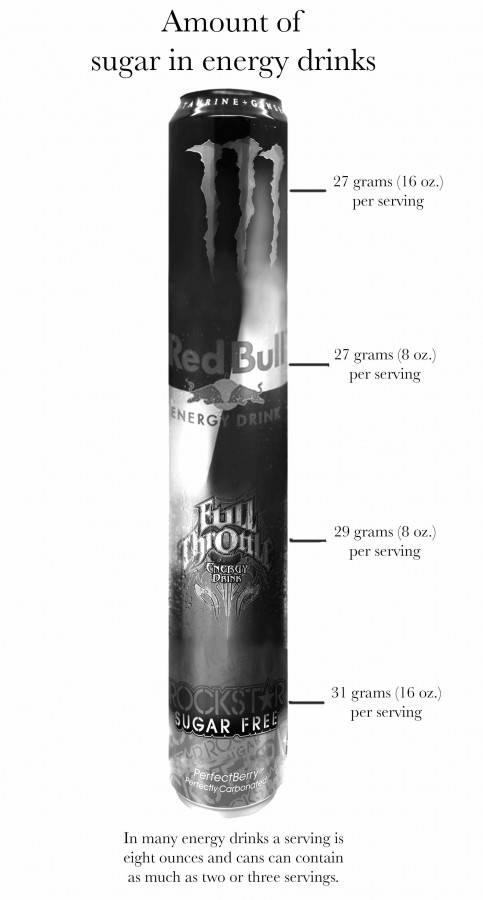
Energy drinks contain stimulants such as caffeine and sometimes guarana plant ,which gives a brief boost to performance. They contain almost as much sugar as a 12 ounce can of Coke, which has 39 grams of sugar.
Energy drinks also have negative psychological effects. According to the National Center for Biotechnology Information website, depression, mood changes, feeling of fatigue, lack of energy and aggressiveness are caused by consuming energy drinks. Sometimes it also can lead to smoking and other addictions as well.
In the email interview with Wolstein she added that the healthiest approach is to limit consumption energy drinks or not at all.
“If someone is heavily exerting themselves for an extended period of time they may want to have sport drink to rehydrate and replenish electrolytes,” Wolstein said.
Are there any sports or energy drinks that teenagers CAN consume?

Tuesday, 17 March 2015

Negative & Positive Effects on People Who Drink Energy Drinks

Negative & Positive Effects on People Who Drink Energy Drinks
 
Energy drinks have become increasingly popular since they were first introduced into the European market in 1987 and then in the U.S. about 10 years later. Manufacturers of these products claim to increase energy, endurance, burn fat and improve athletic performance. The medical community has begun to question the amount of sugars, and safety of caffeine levels and other supplements in these beverages.

Caffeine

Energy drinks contain high levels of caffeine, at 80 to 500 mg per can when compared to 65 to 100 mg for a cup of coffee. Caffeine is a central nervous system stimulant and diuretic. Three cups of coffee -- about 3 -- offer a maximum recommended daily amount of 250 mg of caffeine. Another ingredient often found in these types of drinks is guarana seed extract, from a plant that is native to the Amazon. Guarana is high in caffeine content.


Positive Effects

Caffeine is the main supplement in most energy drinks. It is an appetite suppressant, and has been used effectively in the treatment of migraine headaches and to combat short-term drowsiness and fatigue. According to a UC Davis publication, Guarana has been scientifically linked to increased energy, appetite suppression and athletic performance enhancement.

Negative Effects

Caffeine or guarana consumption can result in increased heart rate, sleeplessness, nausea, anxiety, depression, nervousness, irritability, abnormal heart rhythms -- arrhythmia and late-term miscarriage. Some drugs can interact with either supplement and should be considered prior to consuming energy drinks. A study by the American Heart Association showed significant increases in heart rate and blood pressure with energy drink consumption during sedentary activities. A concern was raised that combining energy drinks with higher levels of physical activity could pose a risk for people with high blood pressure or heart disease.
 
 
Safe Energy Drink Consumption
While the FDA has set a caffeine maximum level at 71 mg for a 12-oz. soda, According to "The Journal of The American Medical Association," it has not set maximums for energy drinks. Further studies on caffeine’s effects are under way with many medical organizations advising adults to consume energy drinks in moderation; and for children and teens to abstain altogether until their safety can be established. New studies have also been concerned with alcohol-based cocktails that include energy drinks. A study published in the February 2011 issue of "Alcoholism: Clinical and Experimental Research" indicates that energy drink-laced cocktails spur continued alcohol consumption because of the stimulating effects of these beverages.
 
Photo Source:  www.robertharding.com


Hey guys what do you feel about daily consumption of energy drinks?