Showing posts with label caffeine. Show all posts

Wednesday, 29 July 2015

How Coca Cola Affects Your Body In 60 Minutes


We all know Coca Cola is laden with sugar and that, at a push, you could use it to clean your toilet. But it's a bit of a mystery as to what it does to your body.
Now, thanks to Niraj Naik, we have the answer to that question.
The brains behind website The Renegade Pharmacist has revealed exactly what a refreshing can of Coke does to your system within the first hour of drinking it. And it's not pretty.
coca cola
First 10 minutes
10 teaspoons of sugar hit your system. (100% of your recommended daily intake.) You don't immediately vomit from the overwhelming sweetness because phosphoric acid cuts the flavour, allowing you to keep it down.
20 minutes in
Your blood sugar spikes, causing an insulin burst. Your liver responds to this by turning any sugar it can get its hands on into fat. (There’s plenty of that at this particular moment)
40 minutes in
Caffeine absorption is complete. Your pupils dilate, your blood pressure rises, as a response your livers dumps more sugar into your bloodstream. The adenosine receptors in your brain are now blocked preventing drowsiness.
45 minutes in
Your body ups your dopamine production stimulating the pleasure centres of your brain. This is physically the same way heroin works, by the way.
60 minutes in
The phosphoric acid binds calcium, magnesium and zinc in your lower intestine, providing a further boost in metabolism. This is compounded by high doses of sugar and artificial sweeteners also increasing the urinary excretion of calcium.
After 60 minutes
The caffeine’s diuretic properties come into play. (It makes you have to pee.) It is now assured that you’ll evacuate the bonded calcium, magnesium and zinc that was headed to your bones as well as sodium, electrolyte and water.
As the rave inside of you dies down you’ll start to have a sugar crash. You may become irritable and/or sluggish. You’ve also now, literally, pissed away all the water that was in the Coke. But not before infusing it with valuable nutrients your body could have used for things like having the ability to hydrate your system or build strong bones and teeth.
On his site, Naik writes: "I discovered that a trigger factor for many widespread diseases of the west such as obesity, heart disease and diabetes could be closely linked to the consumption of one particular substance found in many processed foods and drinks – fructose in the form of high fructose corn syrup.
"High fructose corn syrup is found in pretty much all processed foods such as ready meals, fast foods, sweets and fizzy drinks and most people are totally unaware of its danger."
The Renegade Pharmacist tells HuffPost UK Lifestyle that he was inspired to teach people about their dietary choices after managing to heal himself of a chronic auto-immune condition.
"I used a combination of different techniques that I discovered by researching others who had healed themselves," he explains.
"My method combines self hypnosis, meditation, special breathing exercises based on Himalayan monks, having a very low-carb diet that's free from factory based foods and taking a special supplement called Colostrum."
When Naik worked as a community pharmacist, he says he was able to successfully wean people off longterm medication - particularly for health issues such as high blood pressure or diabetes.
"Many of them would consume fizzy drinks on a daily basis," he says. "A few, on several medications, would consume between two and three cans a day. In one case a guy was on every heart drug under the sun and taking big doses."
Naik went through the patient's diet and found that he was drinking up to 15 cups of coffee a day with 2/3 spoonfuls of sugar in each cup.
"I was even more shocked to find out his doctor had not asked him about what he ate or drank and just stuck him on strong meds for life," he says.
So, the pharmacist created his own system to help patients overcome their conditions.
"My first piece of advice to them would be to do a simple swap," he explains, "replacing fizzy drinks with water and fresh lemon or lime juice.
"In many cases just doing this would have a dramatic effect on their health.
"This indicates to me that fizzy drinks and sugar are big issues relating to blood pressure and metabolic diseases like diabetes and heart disease."
Article Source: http://www.huffingtonpost.co.uk/2015/07/29/how-coca-cola-affects-body-infographic_n_7895304.html?utm_hp_ref=uk-health

Thursday, 2 April 2015

Energy drinks are not a healthy option for teens


Sophomore Albert Amougou stopped consuming energy drinks after he realized how much he relied on them for energy.
“I used to fall asleep during the day and be up all night,” Amougou said. “I was getting hooked to it so I stopped drinking it by the end of freshman year.”
According to the ScienceDaily website, 30 percent of young adults between the ages of 12 to 17 consume energy drinks.
According to a recent survey done by The Pearl Post, there are three common reasons for consuming energy drinks. Either the student likes the taste of the drink, enjoys the boost in energy and/or uses it as a replacement for water. The survey found that Monster energy drink was the most popular brand.
In 2013 in a study by the UCLA Center for Health Policy, a research group found out the number of teenagers who consume energy drinks has increased over the years.
Joelle Wolstein, a graduate student researcher who also contributed in the study, said in a email interview that energy drinks are marketed to improve energy and to help with weight loss, stamina, athletic performance and concentration.
“There are a number of reasons why people consume more sugar-sweetened beverages now than in the past. They include marketing, increased portion size, price and availability,” Wolstein said.
Energy drinks tend to lose their effect fairly easily. Teenagers drink more to get that same effect, which in some cases causes caffeine overdose. The sugar and caffeine can cause addiction but in a low rate.
“I use to drink Red Bull once a week. I haven’t had one for months. If I had more I know I would become addicted to it,” junior Cedric Eusantos said.
According to the U.S Anti-Doping Agency website, energy drinks are often confused and categorized as sport drinks such as Gatorade and Powerade.
Energy drinks can cause a negative physical effect. In her interview from July 2014 with Food Safety News, cardiologist Dr. Stacy Fisher from Maryland University School of Medicine mentioned that there is an increasing number of patients with problems such as palpitations, shortness of breath and nausea due to energy drinks.
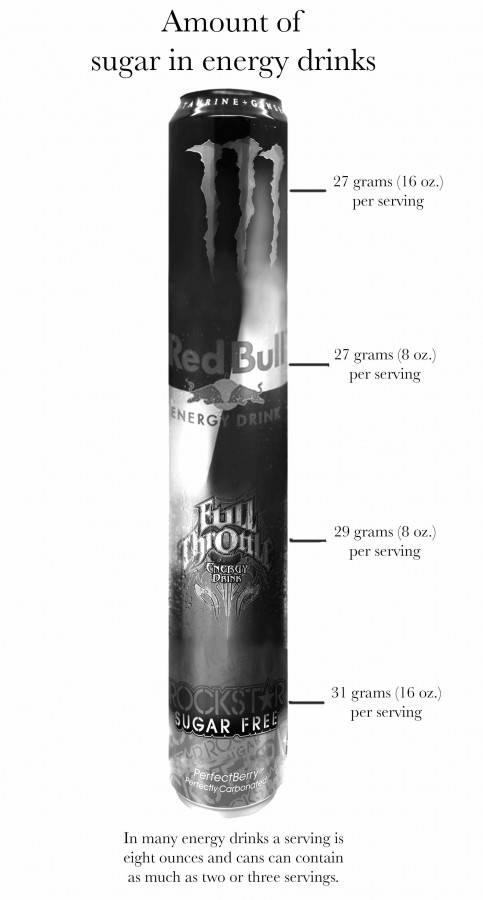
Energy drinks contain stimulants such as caffeine and sometimes guarana plant ,which gives a brief boost to performance. They contain almost as much sugar as a 12 ounce can of Coke, which has 39 grams of sugar.
Energy drinks also have negative psychological effects. According to the National Center for Biotechnology Information website, depression, mood changes, feeling of fatigue, lack of energy and aggressiveness are caused by consuming energy drinks. Sometimes it also can lead to smoking and other addictions as well.
In the email interview with Wolstein she added that the healthiest approach is to limit consumption energy drinks or not at all.
“If someone is heavily exerting themselves for an extended period of time they may want to have sport drink to rehydrate and replenish electrolytes,” Wolstein said.
Are there any sports or energy drinks that teenagers CAN consume?

Caffeine Factor: The Ultimate Guide To Caffeine – Written By Elliot Reimers

Caffeine is one of the most commonplace stimulatory drugs ingested in everyday society, and with that often comes misuse and misinformation. Not surprisingly, when you walk into most any grocery or convenience store you’ll come across a plethora of “energy drinks” infused with copious amounts of caffeine. Many individuals just sort of nonchalantly sip on caffeine throughout the day, since coffee is pretty much the beverage of choice in everyday society.

That being said, if you use caffeine prudently and methodically it can be one of the most beneficial compounds to help you reach your performance and physique goals.
caffeine1
Read on as this guide will bring you everything you need to know about caffeine: What it is, how it works, the benefits and risks of it, and how to use it optimally.

What exactly is caffeine?

On a molecular level, caffeine is an alkaline, organic (i.e. carbon-based) compound that belongs to a class of substances called methylxanthines . Methylxanthines serve to stimulate the central nervous system (CNS) and heart, and they are naturally occurring in coffee beans, tea leaves, some fruits and other foods/plants.
The chemical nomenclature for caffeine is “1,3,7-trimethylxanthine” so some companies may use that on their ingredient label instead.
Physiologically speaking, methylxanthines serve as acetylcholinesterase and phosphodiesterase (PDE) enzyme inhibitors–the latter of which is where we derive most of the performance benefits from. PDE enzymes are responsible for the breakdown of key cell messengers called cyclic adenosine monophosphate (cAMP) and cyclic guanosine monophosphate (cGMP).
Therefore, when PDE enzymes are inhibited, cAMP and cGMP levels increase and the metabolic processes in the cell are more rapid, and thus you feel stimulated.
mountain-dew-x-tremezz

Overview of the effects from stimulating the CNS

Many readers may recall that the CNS is comprised of the spinal cord and brain in humans, and it is the route to send and receive signals between every part of the body. Upon ingestion of PDE inhibitors/CNS stimulants, such as caffeine, degradation of cAMP and cGMP is decreased and the body is sent into a sort of “overdrive” mode.

The primary short-term effects of this are:
  • Increased heart rate
  • Psychostimulation
  • Vasoconstriction
  • Increased (albeit not significantly) metabolic rate
  • Increased urination/excretion
The half-life of caffeine is rather short (about 3-6 hours) so it needs to be properly timed (which will be discussed further later on).
Some of these above effects are desirable, while others may not be very beneficial for performance enhancement (specifically vasoconstriction and frequent urination).

How caffeine can enhance athletic performance

Studies suggest that many of the performance-enhancing benefits of caffeine come from its arousing effects via increases in catecholamine production and bronchodilation. (1, 2) In turn, this leads users to “feel” more amped up when they train and their rate of perceived exertion (RPE) decreases. (3, 4)
Essentially, you feel more able to work harder, longer and thus performance increases.  Obviously this is great for gym-goers as this often results in training improvements, such as more total weight lifted and increased calorie expenditure. On a more physiological (as opposed to psychological) level, caffeine may promote the thermic effect of meals and enhance carbohydrate and fatty-acid metabolism during exercise, however the literature on this is a bit underwhelming at this point. (5, 6)
That being said, caffeine does certainly appear to benefit those looking to shed off fat due to its aforementioned performance-enhancing benefits and a greater capacity to perform work.
sim

Summary of benefits and drawbacks of using caffeine pre-workout

Caffeine is undoubtedly a worthwhile addition to your pre-workout supplement regimen, but it behooves you to use it according to your goals and specific training plans. For example, recreational and competitive bodybuilders have much to gain from caffeine usage, whether they’re looking to build muscle or shed fat. However, certain sport-specific skills require use of precise motor coordination, so for athletes caffeine may hamper performance during a competition.
Be cautious with your caffeine usage prior to sporting events if you tend to be jittery and/or anxious after taking it.

The main ergogenic benefits of caffeine appear to be mediated by:

  • Increased catecholamine (especially adrenaline) production
  • Bronchodilation
  • Increased exogenous carbohydrate metabolism/utilisation
  • Increased fatty acid oxidation

Possible side effects

Like any other drug, there are side effects/undesirable effects to be had from using caffeine, which may include:
  • Dehydration and cramping
  • Jitteriness, Nervousness, Irritability, Anxiety, etc.
  • Increased plasma cortisol levels (this effect is reduced in healthy individuals) (7)
Now don’t think that you will experience all of those side effects just because you use caffeine. Most individuals will not experience a significant amount of these side effects if they’re smart and methodical about their usage. Moreover, these side effects are generally dose-dependent; if you don’t abuse caffeine, you will avoid most of them altogether. Like most any chemical, the difference between medicine and poison is in the dose.
This is good segue into the next section which will discuss just how much caffeine individuals should take and when they should take it.

Proper caffeine dosing

Do to its stimulatory nature, caffeine is a bit more complex than most supplements in regards to maximizing benefits while limiting side effects. Research contends that there is no significant dose-response relation when caffeine is ingested prior to exercise. [8] In essence, taking an excessive amount of caffeine doesn’t confer more benefits and may actually lead to more side effects.
The prudent thing to do is find the “sweet spot” dosage for yourself and cycle your use of caffeine so you don’t become dependent on it.
3-reasons-why-caffeine-supps-can-work_a

So just what is that “sweet spot” dosage you ask?

Research corroborates that, depending on the individuals own sensitivity to caffeine, the best doses range from 1-3mg per kilogram (kg) of bodyweight. [9] For those using the imperial system, a kilogram is equal to 2.2 pounds. Therefore, a 220lb athlete (100kg) would use around 100-300mg of caffeine prior to exercise/competition. You may notice that the range for the recommended dose is rather wide, and this is why everyone will need to use some trial-and-error assessment of their own reaction to caffeine.
Start by using the minimum recommended dose based on your bodyweight and simply increase the dose if you don’t notice much performance enhancement.

Timing caffeine intake

Recall from earlier that caffeine has a half-life of 3-6 hours, so it is advised that you take your pre-workout dose of caffeine about 30-45 minutes beforehand. If you are training on a n empty stomach/fasted you could notice the effects even as quickly as 10-15 minutes after taking it. Most trainees/athletes like to eat a pre-workout meal, and in that case it will likely be best to take caffeine about an hour or two after you’ve eaten.
This should allow enough time for your pre-workout meal to digest and minimize any acute gastrointestinal upset that may occur from caffeine. Again, trial and error is a crucial component to optimizing your intake of caffeine.

Does source matter?

Caffeine is a discrete chemical, so whether it comes from natural (i.e. coffee, tea, chocolate, etc) or synthetic sources (pill/powder form, energy drinks, supplements, soda, etc) it won’t make much of a difference. The most common form of supplemental caffeine is caffeine anhydrous and can be purchased from most any health supplement store. For the idealist, supplemental caffeine powder may be best since you can manipulate exactly how much caffeine you take in by using specific amounts.
However, most energy drinks and pre-workout products will include the caffeine content on their label. For coffee lovers, the general rule of thumb is that a “strong” cup of black coffee contains about 200mg of caffeine.
SEOWB-Google-Caffeine-590-300

How to overcome desensitization

Caffeine has a caveat in that the more you use it, the less sensitive you become to its effects. This in turn gradually increases the amount of caffeine needed to achieve performance benefits. It’s not uncommon to come across habitual coffee drinkers that don’t feel a thing after drinking an entire pot, or they get a short-lived burst of energy and crash about 30 minutes later. It’s safe to say that if you’re at the point where you can guzzle down a few shots of espresso and not notice much, you probably need to back off the caffeine for awhile. Another cue that it’s time to cut your caffeine intake is when the side effects start to outweigh the benefits.
There are a medley of variables that come into play when figuring out how to properly cycle caffeine use to avoid becoming “stimmed out,” but a baseline recommendation is that for every 8-12 weeks of using caffeine you should aim to take 1 to 2 weeks off of it (and most any other stimulants).
Some individuals may notice they tolerate caffeine rather well for months on end, in which case I would say don’t fret too much about cycling off if you’re achieving great results. On the contrary, certain people may need to cycle off caffeine every 3-4 weeks or they become rather dependent on it (i.e. daily functioning becomes daunting without caffeine). If you are only taking caffeine a couple times per week, you could likely keep it in your regimen indefinitely without cycling off at all. Again, it’s wise to listen to your body and experiment.
Once you learn how you respond to caffeine’s effects the process of fine-tuning your dose and usage will be much easier.

Should you use caffeine?

The research on caffeine is rather positive so it is hard to argue against the postulation that most athletic and physique endeavors can be enhanced by using it. For the majority of trainees/athletes though, caffeine needs to be assessed by the user through anecdotal experience to see whether the effects will help them achieve their goals or not. At the end of the day it will be up to the user to decide if they like the way it affects them.
Furthermore, like with most any other supplement or drug, it is best to consult with a licensed physician prior to beginning your usage of such products, especially those with pre-existing medical conditions. Caffeine at sufficiently high doses (>5g) can be lethal, so please be cautious with your use of it.

Summing it up

Hopefully this guide has given you a greater grasp on how to optimize your usage of this popular drug. It’s hard not to recommend caffeine to most any gym-goer, even if you’re just a weekend warrior looking for a little extra pep in your step after a hard week at the office. Then again, you are reading this article on Simplyshredded, so I’d surmise you’re a bit more serious than the average Joe. Now go drink some caffeine and get your sweat on!

The ultimate guide to caffeine!

Tuesday, 31 March 2015

Energy drinks and adolescents: what’s the harm?


Concerns about potential dangers from energy drink consumption by youth have been raised by health experts, whereas energy drink manufacturers claim these products are safe and suitable for marketing to teens. This review summarizes the evidence used to support both sides of the debate. Unlike most beverage categories, sales of energy drinks and other highly caffeinated products continue to grow, and marketing is often targeted to youth under the age of 18 years. These products pose a risk of caffeine toxicity when consumed by some young people, and there is evidence of other troubling physiological and behavioral effects associated with their consumption by youth. The US Food and Drug Administration has indicated it will reexamine the safety of caffeine in the food supply; however, more research is needed to better understand youth consumption of energy drinks and caffeine in general, as well as the long-term effects on health. Meanwhile, policymakers and physician groups have called on energy drink manufacturers to take voluntary action to reduce the potential harm of their products, including placing restrictions on marketing to youth under the age of 18 years. Additional regulatory and legislative options are also being discussed.
Photo Source: www.robertharding.com

"an in-depth look at sports drinks and children"

Monday, 30 March 2015

How Caffeine Boosts Athletic Performance

Wednesday, 25 March 2015

Muscle Building and Fat Loss Tips Using Caffeine

Here is why you should include caffeine in your diet.


1) Caffeine drinkers weigh less
An analysis of some 18,000 individuals showed that caffeine and coffee users weigh less than those who don’t take any caffeine.
2) Caffeine increases energy expenditure and thermogenesis
Using energy to raise body heat is a great way to help burn fat, and caffeine does that well. But that is not all. Caffeine also lowers insulin and glucose, helping users become more metabolically healthy.
3) Caffeine helps you burn more fat during exercise
Caffeine has a glycogen-sparing effect, meaning fat will be preferentially used as fuel during exercise.
4) Caffeine breaks up stored fat so it can be burned
This is called raising free fatty acids. Caffeine helps the body snip up stored fat so it can be burned inside the mitochondria.
5) Caffeine assists with many aspects of cognition
From increases in reaction time to concentration, memory, word recall, and attention span, caffeine helps with it all.
6) Caffeine improves cardiovascular fitness, strength, and power performance
Caffeine use before exercise increases work output and cardiovascular fitness without putting you at risk for heart disease, according to researchers in South Korea.
7) Caffeine reduces perceived exertion and blunts the pain response
This means that you can really push yourself at the gym, and it doesn’t feel as painful or challenging.
8) Swishing caffeine around in your mouth before exercise may increase exercise performance
Studies in sprinters have shown that caffeine swished around in the mouth may further enhance athletic performance and reduce the perceived exertion of exercise. Give this a shot.[8]
9) Green Coffee reduces cortisol production
Fat cells contain an enzyme called 11β-HSD1, which activates cortisol from its inactive metabolite cortisone. Green coffee, it appears, slows down this enzyme.
10) Super-high doses of caffeine are not needed
Scientists in Canada recently revealed that we don’t need super-high doses of caffeine to improve our ability to burn fat and exercise more intensely. Around 100 mg will do the job. 
 
photo source: www.robertharding.com
 
"HOW DOES CAFFEINE AFFECTS YOUR ATHLETIC PERFORMANCE"?
 

Saturday, 21 March 2015

How caffeine impacts sports performance

How caffeine impacts sports performance

People are now more likely to consume caffeine on a daily basis than fruit, and it has been suggested that four out of every five people in western cultures consume caffeine every day. In the United States alone, more than 100 million people drink coffee on a daily basis, while an additional 30 million consume specialty beverages like lattes and cappuccinos. Popular sports dietician Louise Burke, co-author of Caffeine for Sports Performance (Human Kinetics, August 2013), says that while caffeine is consumed daily by the overwhelming majority of the adult population to enhance their well-being and daily activities, athletes are left wondering exactly how it affects their sports performance.
 
According to Burke, caffeine is typically used among athletes to reduce the fatigue or performance decline that would otherwise occur during an event. “An important interpretation of these high rates of consumption is that not all athletes who have caffeine in their system while they train or compete had the intention of gaining a performance advantage,” Burke says. “Indeed some athletes may compete without even realizing they have consumed caffeinated products!”
 
As a result of the high level of background caffeine intake in athletes, caffeine was subject to threshold limits which tried to distinguish between habitual caffeine use and deliberate use for sports performance. Thus, in 2004 the World Anti-Doping Agency (WADA) removed caffeine from their list of prohibited substances and it is still legal today. According to the National Collegiate Athletics Association (NCAA), caffeine is also considered a regulated but not banned substance.
 
After WADA removed caffeine from their list of prohibited substances, Burke provided a pre-race caffeine-related questionnaire to 140 triathletes from 15 countries, including elite and age group participants from the 2005 Ironman Triathlon who were competing in a major international event. The questionnaire investigated caffeine-related knowledge, sources of caffeine information, their experiences using caffeine and their plans for caffeine use throughout the upcoming race. “A large proportion (73%) of these athletes believed caffeine was ergogenic to their endurance performance and 84% believe it improved their concentration during an event,” Burke says. “The most commonly reported positive caffeine experiences related to within competition use of Cola drinks (65%) and caffeinated gels (24%).”
 
Burke notes that the most popular sources of caffeine information were self-experimentation (16%), fellow athletes (15%), magazines (13%), and journal articles (12%). Results also indicated that 124 athletes (89%) planned on using a caffeinated substance throughout the event. One quarter of these athletes, however, remained either confused or uninformed about caffeine’s “legality” in sport.
 
“The athlete’s awareness of caffeine’s position in anti-doping rules was associated with their actual caffeine intake,” Burke explains. “Specifically, the dose of caffeine was higher if an athlete was aware of caffeine’s position as an unrestricted substance - ~ 222 mg in those unaware of the 2004 decision versus ~ 415 mg in those who were aware of the change in caffeine’s status on the WADA anti-doping List.”
 
“In theory, athletes should be able to manage a safe and socially acceptable intake of caffeine intake to prioritize its effect on sports performance within the ethics and rules of their sport,” Burke says. “In practice, however, caffeine use in sport continues to be problematic.”


Caffeine for Sports Performance offers a common sense discussion on the benefits and risks of caffeine use for a wide range of sports. The book enables athletes to decide whether to safely use caffeine, including their habitual daily caffeine intake, to get the most out of their sports while also delving into the health implications of caffeine use. Read more about Caffeine for Sports Performance. 

Article Source: http://www.humankinetics.com/articles/articles/how-caffeine-impacts-sports-performance
Photo Source: www.robertharding.com

So guys do you agree that more than required intake of caffeine causes negative health outcomes?
 

Friday, 20 March 2015

Energy Drink Companies Refuse To Enact Policies Protecting Children: Senate Study

Energy Drink Companies Refuse To Enact Policies Protecting Children: Senate Study

Some of the nation’s largest beverage manufacturers have failed to enact certain policies that could protect minors from the potentially harmful effects of energy drinks, according to the findings of a recent report. 
A survey issued by U.S. Senator Edward J. Markey (D-Mass), titled “Buzz Kill,” indicates that many manufacturers are not following through on certain commitments they made not to target the nation’s youth with their advertising.
In 2013, Senators called on 17 energy drink makers to make voluntary agreements to follow certain guidelines concerning marketing and promotion of energy drink products to children under the age of 18.
The latest study, which tracks the industry’s progress in reaching those guidelines, was compiled by the staff of Senator Markey, in coordination with the staff of Senators Richard J. Durbin (D-Ill) and Richard Blumenthal (D-Conn).
Health officials, parents and legislators alike are concerned about the potential health risks energy drinks may pose for young people, who commonly consumer large volumes of the highly caffeinated beverages.
The movement to protect the nation’s youth is facing resistance from a rapidly growing market, which has aggressively marketed to teens and young adults for years.
 
 
The energy drink market has grown 60% between 2008 to 2012, and is on track to becoming a $21 billion business by 2017. Energy drink sales reach more than $9 billion each year for people of ages 13 to 35. More than 30% of teens under 18 have admitted to regular consumption of energy drinks.
The group of senators received responses from 12 energy drink companies concerning those commitments. The companies included Red Bull, Monster Energy Company, Rockstar, Inc, Arizona Beverages USA, Celsius Inc, XYIENCE, The Coca-Cola Company, and Dr. Pepper Snapple Group.

Companies Reluctant To Commit

Overall, only one energy drink company, XYIENCE, committed to all specific measures concerning age restrictions and marketing proposed by the Senators in the 2013 letter. Those measures included labelling products as not intended for youth under 18, restricting advertising where more than 35% of the audience is under 18 years of age, restricting social media for children under 18, and avoiding featuring teens under 18 in ad campaigns.
 
Only four of 12 companies, Arizona, Celsius, XYIENCE, and Coca-Cola, committed to not market their energy drink products to youth.Red Bull, Monster, Rockstar and Dr. Pepper/Snapple declined to commit to this measure. These four companies make up more than 90% of the energy drink market. However, all the companies did agree not to market energy drinks to children under the age of 12.
 
All but one company agreed not to sell products in K-12 schools, however two would not commit to stopping their distributors and other partners from selling in schools. Six of 10 companies agreed to voluntarily report adverse events stemming from energy drink consumption to the FDA. Three companies said they would consider reporting the events, and one company completely refused.
 
Members of the American Beverage Association agreed to refrain from marketing energy drinks for rehydration or with electrolytes, similar to sports drinks. However, Monster, Rockstar and Coca-Cola, all members of the ABA, continue to market the drinks like sports drinks. This especially concerns health advocates because it can lead consumers to drink large quantities for energy drinks for rehydration, while consuming large amounts of caffeine.
A study published late last year found while energy drinks may often boost athletic performance in some athletes who consume the drinks, they also experienced increased insomnia, nervousness and other side effects.
The top four energy drink companies, Red Bull, Monster, Rockstar and Dr. Pepper, had major gaps in their commitments to protect teens from marketing campaigns.
 
In comparison, Arizona, Celsius, XYIENCE and SK Energy, demonstrated high commitments to implementing and following policies that would protect children from harmful advertising campaigns.
Most companies implemented some measures to discourage misuse of energy drinks, including product labelling of caffeine content, and warning against rapid or excessive consumption, or mixing with drugs or alcohol.
Research published last year in the medical journal Alcoholism: Clinical and Experimental Research concluded mixing energy drinks with alcohol may give drinkers a greater urge to consume higher amounts of alcohol, causing those drinkers to have higher blood alcohol levels.
Another study published last year found that young children who consume energy drinks may face serious health risks, including seizures, heart problems, chest pain and erratic heart beats.
 
Photo Source: www.robertharding.com


Guys this issue of energy drink's advertising is not new and its still not too late for all, specially young children to control its intake.